
What they do, how they work, and which one is right for your hair.
If you've had your hair professionally colored in the last decade, chances are you've heard the term bond builder.
Maybe your stylist has mixed one into your lightener. Maybe you've invested in a tiny bottle of K18 that costs more than your dinner. Or maybe you've been using Olaplex for years without really understanding what it does.
But what exactly are these products repairing? Are they all doing the same thing? And are they really worth the investment?
Let's get into the science of good hair.
First, a Little Hair Chemistry
Your hair is made primarily of a protein called keratin. Within each strand are various chemical bonds that help give your hair its strength, elasticity, and shape.
There are three commonly discussed types of bonds in hair:
Hydrogen bonds: Temporarily disrupted by water and heat. These are why you can change the shape of your hair with a blow dryer or curling iron.
Salt bonds: Sensitive to changes in pH.
Disulfide bonds: Strong chemical bonds that play a major role in your hair's structural integrity and natural texture.
Chemical services like bleaching, permanent color, perms, and chemical straightening can compromise your hair's internal structure. Excessive heat styling, UV exposure, and everyday wear and tear can also contribute to damage.
When enough damage accumulates, your hair can become brittle, overly porous, difficult to manage, and prone to breakage.
Enter the bond builder.
Unlike traditional conditioners, which primarily improve the surface of the hair, bond-building treatments are designed to reinforce or repair aspects of its structure. However, not all bond builders work the same way.
B3 Brazilian Bond Builder: The Colorist's Sidekick
B3, short for Brazilian Bond Builder, is a professional treatment that can be mixed directly into hair color or lightener.
Its technology focuses on the cell membrane complex (CMC) — essentially the material that helps hold the different cells of your hair together. Think of it as the mortar between bricks.
B3 uses a specially engineered copolymer designed to reinforce this structure and help minimize damage during chemical services.
What makes B3 different?
It works during your color service.
It can be added to permanent color, lightener, glosses, and fashion colors.
It helps reduce breakage during chemical processing.
It's designed to improve color retention and vibrancy.
It doesn't require additional color processing time.
Who is it great for?
Anyone who regularly colors their hair, particularly blondes, vivid color clients, and those undergoing significant color transformations.
B3 is an excellent option for helping maintain the integrity of your hair while achieving your desired color.
And when you're investing hundreds of dollars in your hair color, keeping that color looking beautiful for longer is certainly a welcome bonus.
Olaplex: The Original Bond-Building Game Changer
When Olaplex entered the professional hair industry in 2014, it changed the way many stylists approached chemical services.
Its patented active ingredient, bis-aminopropyl diglycol dimaleate (say that three times fast), is designed to reinforce compromised disulfide bonds within the hair.
These bonds are particularly vulnerable during chemical processing, which makes Olaplex a popular choice for blonding and color correction services.
How does Olaplex work?
The original professional system consists of two steps:
No. 1 Bond Multiplier: Added to color or lightener, or used as part of a standalone treatment.
No. 2 Bond Perfector: Applied following the chemical service to continue the repair process.
Olaplex also offers an extensive range of at-home products, including its well-known No. 3 pre-shampoo treatment.
What makes Olaplex different?
It specifically targets disulfide bond damage.
It can be used during chemical services or as a standalone treatment.
It helps improve hair strength and resilience.
It offers professional treatments and at-home maintenance options.
Who is it great for?
Clients with chemically processed hair, frequent blonding appointments, compromised elasticity, or damage from repeated chemical services.
K18: The Molecular Repair Powerhouse
K18 takes a different approach to hair repair.
Rather than relying on the same chemistry as traditional bond builders, K18 uses a patented biomimetic peptide called K18PEPTIDE™.
Peptides are short chains of amino acids — the building blocks of proteins. K18's peptide is designed to mimic parts of the hair's natural keratin structure and help reinforce damaged areas within the hair.
The company describes its technology as targeting both damaged polypeptide chains and disulfide bonds.
Think of it this way: if your hair's internal structure were a ladder, K18 aims to address damage to both the rungs and the sides.
What makes K18 different?
It uses peptide-based molecular repair technology.
It targets damage from chemical services and heat styling.
Its signature leave-in mask requires just four minutes before styling.
It offers professional pre-service and post-service treatments.
Its at-home mask is highly concentrated, so a little goes a long way.
Who is it great for?
Clients with significant chemical or heat damage, overprocessed hair, compromised elasticity, or curls that have lost some of their natural bounce due to damage.
A quick note about using K18 at home:
Unlike a traditional hair mask, K18 should be applied to freshly shampooed, towel-dried hair before conditioner. Allow it to sit for four minutes before applying additional products, and don't rinse it out.
The manufacturer recommends using it for four to six consecutive washes initially, then as needed for maintenance.
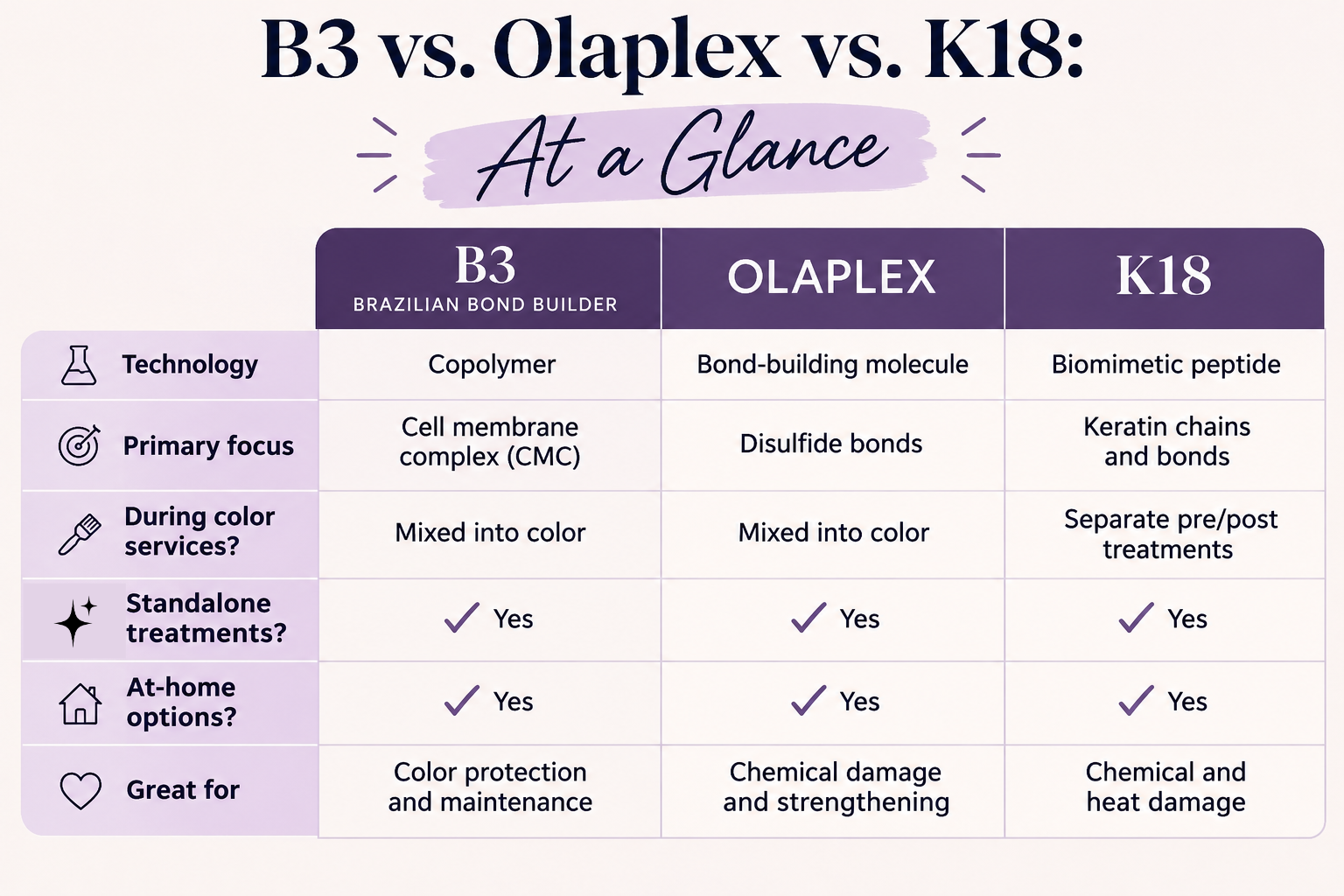
B3 vs. Olaplex vs. K18: At a Glance
So, Which Bond Builder Is the Best?
Here's the answer nobody wants to hear: It depends on your hair.
These three brands use different technologies to address hair damage. One isn't necessarily superior to the others in every situation, and their individual performance claims aren't always directly comparable.
Your ideal treatment depends on your hair's current condition, chemical history, styling habits, and long-term hair goals.
Someone maintaining a vibrant copper may have different needs than someone transitioning from years of black box dye to blonde. And someone who flat-irons their natural curls every morning may need a completely different approach altogether.
This is where your stylist's expertise comes in.
Can You Use Too Many Bond Builders?
More isn't always better.
While bond builders can be incredibly beneficial, they shouldn't replace every other product in your haircare routine.
Your hair still needs conditioning, lubrication, heat protection, and gentle handling. Overusing certain treatments or layering too many products can leave your hair feeling stiff, coated, or difficult to manage.
And no, bond builders aren't automatically protein treatments. Their ingredients and mechanisms vary considerably.
A balanced haircare routine is much more effective than throwing every expensive repair product you can find at your hair and hoping for the best.
(Your bank account will thank you, too.)
What Bond Builders CAN'T Do
As much as we love these products, let's manage expectations.
Bond builders are not a permission slip to abuse your hair.
They cannot:
Make bleaching completely damage-free.
Permanently eliminate split ends.
Restore every severely damaged strand to its original, virgin condition.
Undo unlimited heat or chemical damage.
Replace proper haircuts, conditioning, and professional judgment.
Hair is not living tissue once it emerges from your scalp. While we can improve its strength, appearance, and manageability, it cannot biologically heal itself like your skin can.
Sometimes, the best treatment for severely compromised ends is a pair of shears.
We know. Nobody likes that answer.
The Bottom Line
Bond-building technology is one of the most exciting advancements in modern haircare. It allows us to explore more creative color possibilities while helping preserve the integrity of your hair.
But the real magic happens when professional treatments are combined with thoughtful color formulations, realistic expectations, and a consistent at-home haircare routine.
At Katie Blue Salon, we believe beautiful hair starts with healthy hair. If you're unsure which bond-building treatment is right for you, ask your stylist at your next appointment.
We'll help you build a routine that makes sense for your hair, your lifestyle, and your budget.